
Ultracentrifuges
Ultracentrifuges are advanced, high-speed centrifuges designed to separate extremely small particles — such as viruses, ribosomes and macromolecules — at very high centrifugal forces. Capable of reaching speeds of greater than 100,000 RPM, ultracentrifuges allow for the precise separation and purification of subcellular components and nanoparticles based on their density. These powerful laboratory instruments are essential in molecular biology, biochemistry and nanotechnology, facilitating critical tasks such as virus isolation, nucleic acid extraction and protein complex analysis. Their ability to achieve such high speeds and forces makes ultracentrifuges indispensable for detailed molecular and structural studies in research and clinical laboratories. D.A.I. Scientific is proud to provide our customers with high-quality ultracentrifuges from Beckman Coulter, a trusted centrifuge manufacturer for more than 70 years.
Browse Benchtop Centrifuges
Browse Floor Model Centrifuges
Browse Microcentrifuges

Understanding Ultracentrifuges
- What is an ultracentrifuge?
An ultracentrifuge is a high-speed centrifuge that generates extreme centrifugal forces to separate small particles for research, such as viruses, ribosomes, proteins and nucleic acids. - How ultracentrifuges work
Ultracentrifuges use centrifugal force to separate biological particles, spinning samples at 80,000–100,000 RPM and generating forces of up to 800,000 x g. - Applications for ultracentrifuges
Ultracentrifuges are commonly used for research in molecular biology, biochemistry and the pharmaceutical industry. Applications include genomics and proteomics, virus purification, liposome and nanoparticle research, density gradient separations and R&D.
- Types of ultracentrifuges available
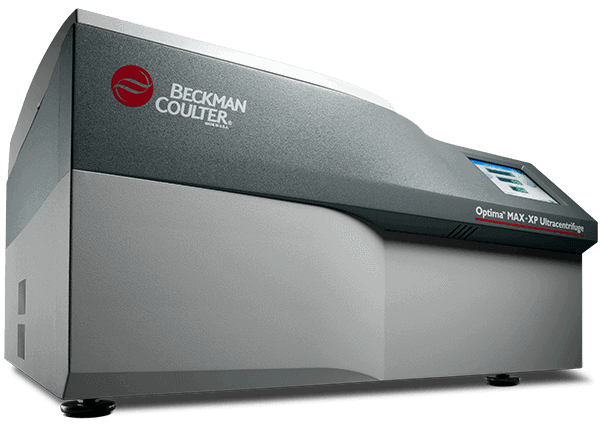
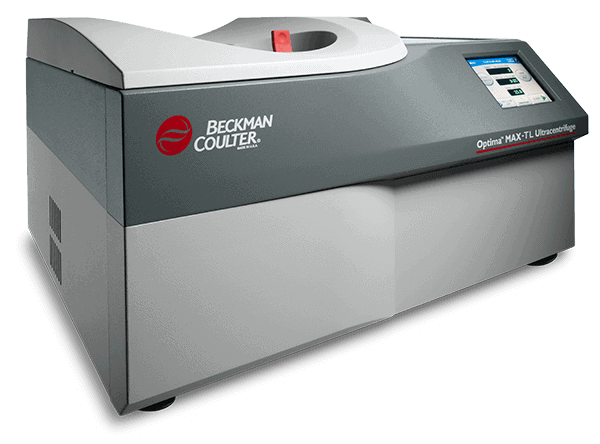
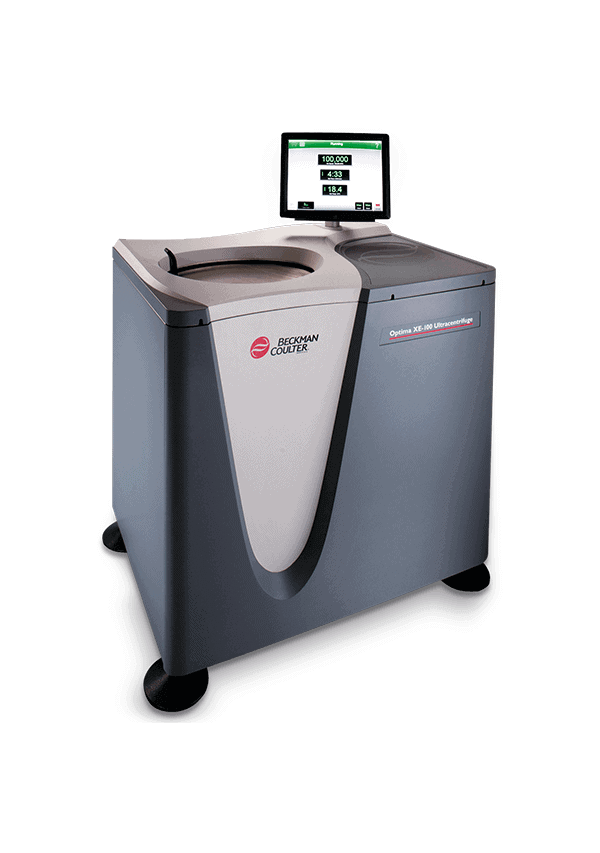
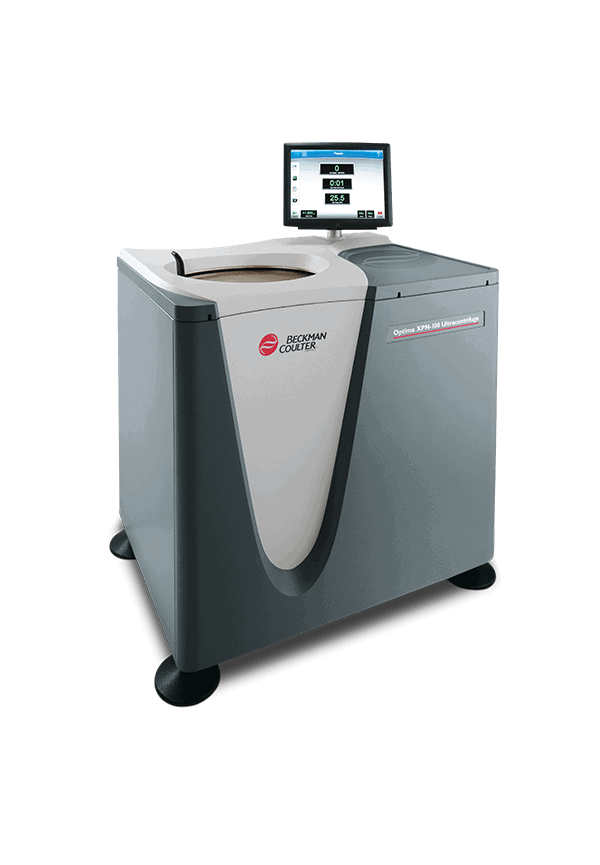
There are two types of ultracentrifuges, analytical and preparative, which come in benchtop and floor-standing models. D.A.I. carries Beckman Coulter’s Optima MAX-XP, MAX-TL, XPN and XE. - Why D.A.I. Scientific
We offer high-quality ultracentrifuges from Beckman Coulter, from compact benchtop units to floor-standing systems. Each unit is quoted to your configuration, with honest lead times and a local rep who will be accessible to you, even after purchase.
Trusted By





Frequently Asked Questions
What is an ultracentrifuge used for?
An ultracentrifuge is used to separate and purify extremely small particles that ordinary centrifuges can't isolate, such as proteins, nucleic acids, viruses, ribosomes and subcellular organelles. Researchers depend on it across molecular biology, biochemistry and virology for work such as protein purification, viral particle separation, DNA and RNA fractionation, and preparing viral vectors for vaccines. Pharmaceutical and biotech labs also rely on it wherever sample purity is critical.
What’s the difference between a centrifuge and an ultracentrifuge?
The difference between a centrifuge and an ultracentrifuge comes down to speed, and with it, the size of particle each can separate. A standard centrifuge spins up to about 30,000 RPM (roughly 110,500 x g), enough to pellet cells, debris and large organelles. An ultracentrifuge reaches 80,000 to 100,000 RPM and forces up to 800,000 x g, isolating far smaller particles. It also calls for more careful sample preparation, often with a gradient medium.
What are the different ultracentrifugation techniques?
There are several ultracentrifugation techniques, including differential ultracentrifugation, sedimentation velocity, sedimentation equilibrium and density gradient ultracentrifugation.
- Differential ultracentrifugation applies a series of faster spins that drop the densest particles out first. Labs often use it to isolate organelles.
- Sedimentation velocity tracks how quickly particles move through the solvent, which exposes molecular weight and protein interactions.
- With sedimentation equilibrium, centrifugal force and diffusion settle into balance, giving a macromolecule's weight even when its shape is unknown.
- Density gradient ultracentrifugation bands particles by buoyant density, using either the isopycnic or the rate-zonal approach.
Do I need an ultracentrifuge, or will a regular centrifuge work?
A regular centrifuge works as long as you're separating larger particles like cells, debris or organelles, which pellet at speeds up to about 30,000 RPM. You need an ultracentrifuge once your targets get much smaller, since viruses, ribosomes, proteins and nucleic acids only separate under the far greater force it generates. Density gradient work also requires ultracentrifugation.
Do I need a tabletop or a floor-standing ultracentrifuge?
A tabletop (benchtop) ultracentrifuge is the right pick for smaller sample volumes and labs where bench space is tight. Size up to a floor-standing model if you run larger volumes or need bigger rotors for higher throughput. Both reach full ultracentrifuge speeds, so your volumes and available space will dictate which option is right for your lab.
How do I choose the right ultracentrifuge for my lab?
To choose the right ultracentrifuge, start with what you're separating and how much of it you have, since the particle type and sample volume will determine the speed, g-force and rotor you'll need. The amount of available space in your lab will also inform which model is right for you. The rotor count is also important to consider, since fixed-angle, swinging-bucket and vertical designs each fit different techniques.